A Foundational Leader of the Perth Jewish Community
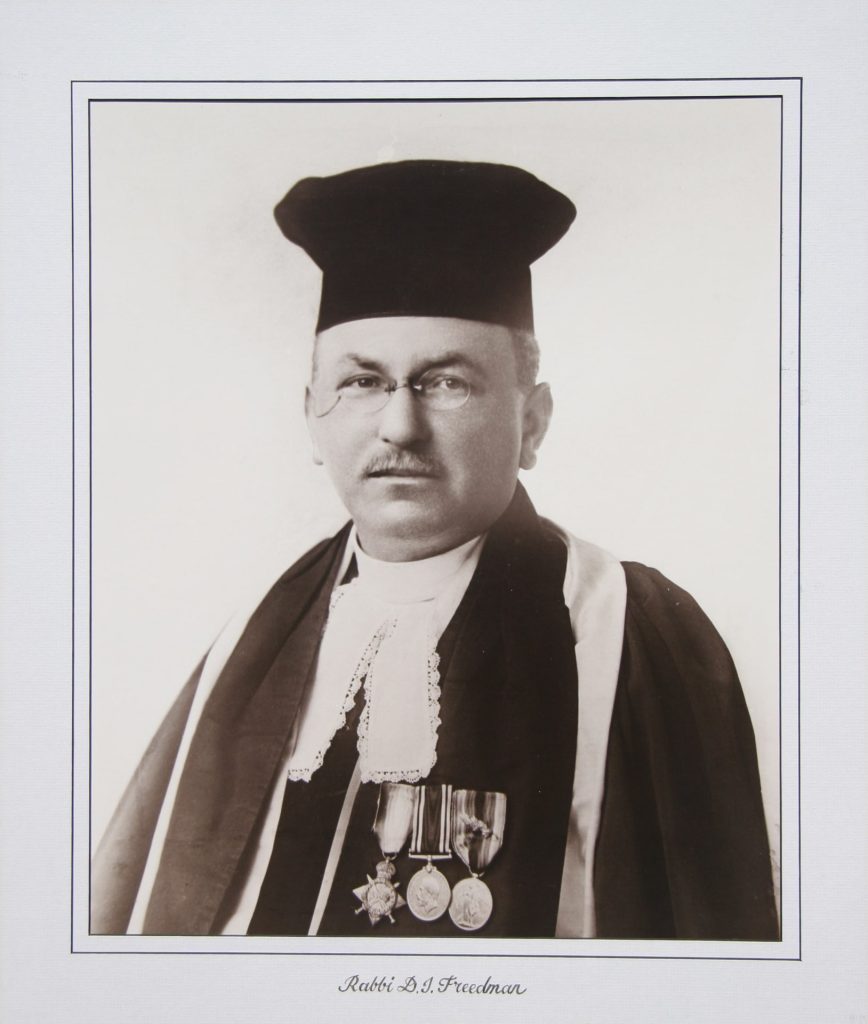
Rabbi David Isaac Freedman was one of the most influential figures in the history of Jewish life in Western Australia. Born on 17 April 1874 in Budapest, he moved with his family to London as a young child, where he received a strong Jewish and academic education at Bell Lane School, Jews’ College, and the University of London. Encouraged by renowned author Israel Zangwill, he began writing early in life and contributed to several journals before becoming a naturalised British citizen in 1889.
Arrival in Western Australia
In 1897, Rabbi Freedman travelled to Western Australia aboard the Ophir to serve the Perth Hebrew Congregation. Soon after his arrival, he married Anne Florence (Mollie) Cohen, and together they raised two sons. His warmth, intellect, and charismatic presence quickly made him a central figure in the growing Jewish community.
Education, Culture & Community Building
Rabbi Freedman was deeply committed to Jewish education and cultural life. As headmaster of the Perth Hebrew School, he modernised teaching methods and composed more than 150 songs to help children learn the core teachings of Judaism. He founded the Perth Hebrew Philanthropic Society, supported victims of the 1903 Kishineff pogrom, and encouraged broad cultural engagement through literature, music, sport, and community events.Beyond the Jewish community, he contributed widely to Perth’s civic and cultural life, editing the West Australian Craftsman and participating in numerous charitable and educational organisations.
Military Service & Leadership Abroad
In 1915, Rabbi Freedman was appointed a chaplain in the Australian Imperial Force, serving Jewish soldiers in Gallipoli, Egypt, and France. Known for his compassion, he wrote personally to the families of every Jewish soldier he encountered. In 1916, the British War Office appointed him chaplain to all Jewish servicemen in the Mediterranean Expeditionary Force. His dedication earned him a mention in dispatches in 1917.Upon returning to Perth, he was formally recognised as a rabbi by London authorities. The community’s strong protest against his proposed transfer to Sydney in 1920 ensured he remained in Western Australia for the rest of his life.
Zionism, Advocacy & Public Service
Rabbi Freedman was a passionate Zionist and served as president of the Western Australian Zionist Association. His leadership extended far beyond the Jewish community, including roles in:
He was also a respected public speaker on literature, history, and social issues.
International Representation & Public Advocacy
From 1932 to 1938, Rabbi Freedman served on the Senate of the University of Western Australia. In 1933, he represented Western Australia at the British Empire Service League Congress in London and later joined the Australian delegation to the League of Nations in Geneva, where he spoke on the urgent plight of German Jews.In 1934, he publicly condemned rising antisemitism in Australia and urged the Federal Government to criminalise racial propaganda. His service and leadership were recognised in 1936 when he was appointed an Officer of the Order of the British Empire (O.B.E.).
Character, Legacy & Commemoration
Rabbi Freedman was admired for his energy, diplomacy, humour, and unwavering commitment to his community. Known for his monocle, waxed moustache, and love of cricket, tennis, and golf, he built bridges across religious and cultural divides.He passed away on 24 June 1939 while attending a hospital committee meeting, leaving behind his wife, sons, and a legacy of extraordinary service. More than 2,000 people attended his funeral at Karrakatta Cemetery — a testament to the impact he had on Western Australia.
Today, his legacy lives on in Freedman Avenue in Mount Lawley, home to the Jewish Centre and the Perth Hebrew Congregation, honouring a man who shaped the spiritual, cultural, and civic foundations of Jewish life in Perth.